How to read the scale?
Brief explanation
The scale shows how big the GAP for a given country in the given area(s) and aspect(s) is. The numerous scale of 0-100, where 100 indicates no restrictions in the most accurate treatment or diagnosis and 0 represents lack of access to the preselected interventions or services, is presented as color scale with best results (75 points and more) painted in green, worst results (25 points or less) painted in violet and the wide range of medium results presented in blue. With the exception of the green subscale, the darker shade relates to worse results.
The combined scores for a given country and disease generally are low to medium, which indicates the high need for better treatment opportunities. In terms of the scale that means that the bars are painted mostly in blue, with the pale color indicating limited restrictions to the reference treatments or services and the deep blue representing the substantial gap in access to therapies.
How to read the scale?
The scale shows how big the GAP for a given country in the given area(s) and aspect(s) is...
The gap in access to therapies in V4 is high - it's time to act.
Although significant improvement has been observed in the last two decades in access to innovative therapies, there are several further critical points still to be taken care of in order to provide the most optimal treatment in the region. The GAP (GEARING UP ACCESS PROPOSAL FOR V4) tool prudently measured the access in selected therapeutic areas in the Visegrád Group (V4) countries (Poland, Hungary, Czechia, and Slovakia) with the optimal standard of care as a benchmark. The performed analysis allowed identification of certain lags in availability to care.
Despite the natural conformity of these likeminded countries, at least several differences can be observed in healthcare accessibility. For each country, there are therapeutical areas with better and worse situation. Overall, the access to care in the V4 is however far from optimal, which clearly confirms the instant need for intervention to improve access throughout the region.
59
Poland
In Poland, the most significant barriers to access to diagnostics and treatment occurred in chronic diseases, while in the area of rare diseases a notable trend was observed; in oncology, Poland’s result is the highest among the evaluated countries.
63
Czech Republic
In the Czech Republic, the results indicate a similar level—and, compared with the other countries, a relatively moderate level of barriers to access to innovative treatment across all areas.
52
Slovakia
In Slovakia, the highest level of limitations is observed in the area of rare diseases, while the highest score was achieved in common diseases. However, in each area the level of limitations remains significant.
53
Hungary
In Hungary, the level of limitations in access to healthcare is very similar across all analyzed areas; the lowest score was recorded in rare diseases, while slightly higher scores were observed in common diseases and oncology.
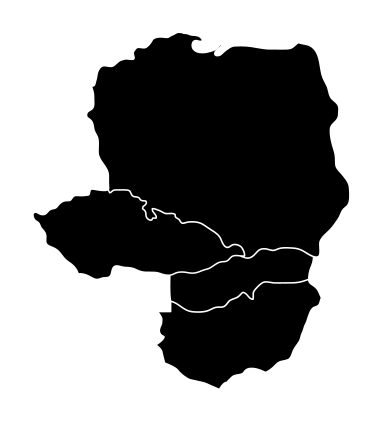
It is time to act.
The analysis is based on the GAP indicator - an aggregated result of a multi-criteria, specific key indicator framework, which allows to compare the results for each indication and for each country on several levels in a flexible way. All indications are evaluated using 8 similar indicators capturing different aspects of patient access (including availability, affordability and accessibility of medicines as well as diagnostics) that resulted in a regretful conclusion that all V4 countries have substantial GAPs in health care access as measured in each of the 11 carefully selected diseases.
However, despite this unfortunate diagnosis, this unique analysis is not for blaming ourselves for the difficulties of an evidently complex issue, but to hopefully support decision makers and other stakeholders in adjusting for the upcoming innovations in health care in V4. Disclosed differences may become motivators to promote equal access to health care across V4 countries and indicate the directions of needed actions towards improvement for the stakeholders.
Disease landscape
Lung cancer (NSCLC)
The GAP analysis for non-small cell lung cancer (NSCLC) revealed significant limitations in access to both diagnosis and treatment.
Read more
Breast cancer
In the V4 countries, a moderate level of restrictions was identified in access to both diagnosis and treatment of breast cancer assessed together. Overall GAP results in analysed countries are varying from 44 to 59 points.
Read more
Prostate cancer
The report identified moderate limitations in access to the diagnosis and treatment of prostate cancer in the Visegrad Group (V4) countries.
Read more
Ovarian cancer
The GAP analysis revealed relatively modest limitations in access to ovarian cancer treatment and diagnosis in the Visegrad Group (V4) countries.
Read more
Cystic fibrosis
Limitations in access to treatment and diagnosis of cystic fibrosis in the V4 region do not differ significantly between countries — the gap between higher-scoring countries (the Czech Republic and Poland) and lower-scoring ones (Slovakia and Hungary) is approximately 9 points.
Read more
Leukemia (AML)
In Visegrad Group (V4) countries, moderate to significant limitations in access to AML diagnosis and treatment have been identified.
Read more
Lymphoma
In the Visegrad Group (V4) countries, a high level of limitations in the diagnosis and access to the latest treatment options for lymphomas was observed, as measured by the GAP scale.
Read more
Diabetes mellitus
In the Visegrad Group (V4) countries, moderate to severe limitations in access to both the diagnosis and treatment of diabetes were identified. At the same time, clear differences between countries are observed—the score for Poland is 44 points, while Slovakia and the Czech Republic score 65–68 points.
Read more
Multiple sclerosis
In the Visegrad Group (V4) countries, significant limitations in access to treatment and diagnosis of multiple sclerosis have been identified, as measured by the GAP index.
Read more
Asthma
In the Visegrad Group (V4) countries, moderate limitations in access to asthma diagnosis and treatment were identified, as measured by the GAP indicator.
Read more
Cardiology
Across all countries of the Visegrad Group (V4), significant limitations in access to the diagnosis and treatment of cardiovascular and related diseases were identified, as measured by the GAP indicator.
Read more
The high need for care improvement in V4 Read more
Disease landscape
Conclusion
There is a need for rapid improvement of health care in V4 countries. The reimbursement of novel drugs is delayed and the number of patients that could have been diagnosed or treated is significantly limited. It all has a direct effect on the quality of care. The situation is specific for each therapeutic area, but in general, it can be easily stated that all V4 countries have substantial GAPs in the access to medicines and diagnostics.
Cross-country overview
The GAPs in V4 are driven mainly by the reimbursement restrictions and limited number of technologies covered by the public payer.

Poland
The most considerable GAPs in the health care access are in chronic diseases. By contrast, the results in the area of oncology and rare diseases stands out favourably with those obtained in the other countries.

Czechia
In the Czech Republic, the level of limitations in access to healthcare is fairly similar across all analyzed areas. The identified barriers to treatment and diagnostics are lowest in rare diseases; however, the results for chronic diseases are also clearly better than in the other countries analyzed.

Slovakia
In Slovakia, the highest level of limitations is observed in rare diseases, while the best results are recorded in common diseases. Although Slovakia is the only country where this area achieves the most favorable outcome, the level of limitations in this domain remains relatively high.

Hungary
In Hungary, the level of limitations in access to healthcare is very similar across all analyzed areas. The lowest level of limitations is observed in rare diseases, while slightly higher results are seen in common diseases and oncology.
FIVE YEARS OF GAP: COMPARATIVE INSIGHTS
Overall GAP Index
Between 2022 and 2024, all analyzed countries show a clear increase in the index values, indicating systematic improvement in access to modern therapies. The strongest growth is observed in Poland (from 41.6 to 58.0 points) and in the Czech Republic (from 50.2 to 68.8). Hungary and Slovakia also improve over this period, although to a lesser extent.
From 2025 onwards, the trend changes, with most countries showing either stabilization or a decline in the GAP index. Poland, after reaching 61.5 in 2025, records a decrease to 58.5 in 2026. The Czech Republic declines from 68.8 (2024) to 62.5 (2026), while Hungary and Slovakia continue a gradual downward trend starting in 2024 and 2025, respectively. Over the entire observation period, the Czech Republic remains the top-performing country, with Poland maintaining a relatively strong position.
In summary, the analyzed period can be characterized by a phase of dynamic improvement up to around 2024, followed by stabilization or moderate deterioration in results. The relative differences between countries remain broadly consistent: the Czech Republic retains its leading position, Poland demonstrates substantial improvement and stabilization at a relatively high level, while Hungary and Slovakia show less sustained gains following their initial increases.
Time to reimbursement
In the period 2022–2026, the average time from marketing authorization to reimbursement shows a consistent upward trend, both at the aggregate level and across most countries. The average calculated “by processes” increases from 940 to approximately 1089 days, while the average “by countries” rises from 959 to 1108 days. It should be noted that this trend should be partially interpreted in the context of the expanding observation horizon, which increases the maximum possible waiting time and therefore affects the distribution of results.
In summary, although methodological factors partially explain the observed increase in the indicator, the magnitude and consistency of the trend point to the growing importance of systemic factors. The Czech Republic maintains relatively highest efficiency in reimbursement processes, Poland remains a country with high and variable indicator values, while Hungary and Slovakia are characterized by a clear and persistent lengthening of time to reimbursement.
At the country level, substantial differences persist. Poland, despite recording the highest values in the dataset, shows a clear improvement in 2023 (1120 days), followed by a subsequent increase over 2024–2026, reaching 1211 days. The Czech Republic remains the country with the shortest reimbursement time, although it also exhibits a gradual increase (from 776 to 863 days). Slovakia and Hungary show the most unfavorable developments – in the case of Slovakia, an increase from 897 to 1120 days (with the 2025–2026 level stabilizing at this value), while Hungary records a continuous increase up to 1237 days, representing the highest value in the final year of the analysis.